EXHIBITION /WOHNUNG
LOCATION /ZURICH, 2014-2015
abstract /A project about transforming the
private living space into
a site of artistic production, encounter
and exchange.
STATEMENT
Wohnung was a project that unfolded over a period of two years in an apartment awaiting complete renovation. This transitional space became a site of artistic and human experimentation, blending an artist residency with a place of production. Each month, a new installation was added to the previous ones, coexisting with them in an evolving composition until the eventual move.
The interventions, designed to respond to the specificities of the space, were integrated into various parts of the apartment. Over time, they interacted with the existing creations, extending from the bathroom to the rooftop terrace and transforming every corner into a unique experience.
Wohnung was not just an artistic space but also a place for encounter and exchange. The intimacy of a private space was temporarily opened to the public, creating opportunities for discussion and sharing. An exhibition could take the form of a single evening, a vernissage, or a moment of connection.
The project explored themes of living spaces, the boundaries between private and public realms, real estate speculation, and how these issues shape our lives. Time, the quality of exchanges around art and culture, personal experiences, hospitality, and dialogue defined the essence and uniqueness of Wohnung’s approach.
PARTICIPATING
ARTISTS
ISSUE #1
ALDO MOZZINI
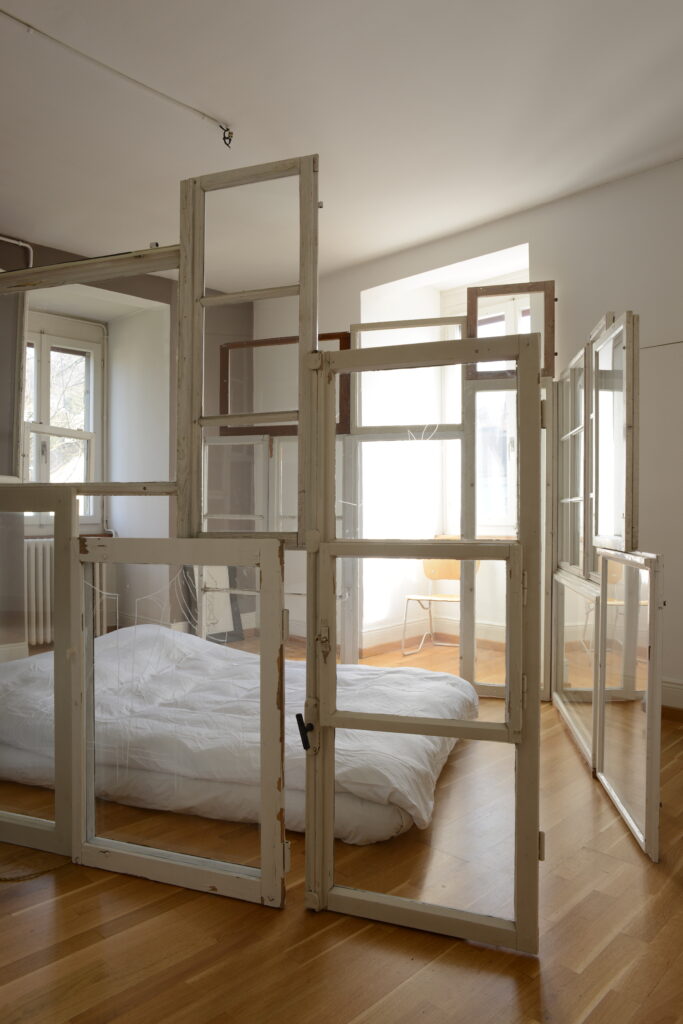
Aldo Mozzini’s installation, which inaugurated the Wohnung series, was situated in the bedroom. It consisted of a structure made from windows salvaged from buildings awaiting demolition and reassembled to frame the bed.
Through a play of transparency, the artist created a tension between exposure and the protection of intimacy: the bedroom, a deeply personal space, became visible—almost spectacular—while still retaining its function as a refuge.
Suspended between a castle and a childhood dream, the installation evoked a fragile, luminous crystal palace. Both screen and enclosure, it gathered the intimacy of the night while simultaneously revealing it, transforming sleep into an act that was at once secret and shared.
ISSUE #2
NILS NOVA
For the second iteration of Wohnung, artist Nils Nova was invited to intervene in the apartment. In the dining room of this old, typically Zurich apartment, the artist multiplied both spaces and doorways within a relatively small room.
Through a play of illusion and deception—characteristic of Nova’s often monumental installations—the space, and above all our perception of it, was subjected to a strange distortion of perspective, compelling the viewer to rethink not only spatial boundaries but also the way perception unfolds over time.
ISSUE #3
AUGUSTIN REBETEZ, NOÉ CAUDERAY & LOUIS JUCKER
For the third event in the Wohnung series, the building’s rooftop became the site of a performative installation by AUGUSTIN REBETEZ, NOÉ CAUDERAY, and LOUIS JUCKER.
Augustin Rebetez and Noé Cauderay, whose multifaceted practices conjure strange, hybrid worlds of imagined creatures and poetic narratives, brought an exuberant, otherworldly sensibility to the rooftop, creating a space that blurred dream and reality.
Meanwhile, Louis Jucker activated the improvised stage with a live concert rooted in his distinctive DIY approach to music—lo-fi folk, experimental songcraft, and handmade instruments—which enveloped the evening in an intimate, exploratory sound environment. As the sun set, participants gathered for a festive night of performance and transforming the rooftop into a lively shared experience.
ISSUE #4
SABINE THOLEN
For the fourth encounter in the Wohnung series, Sabine Tholen chose to install her work in the apartment’s living room. Her practice often returns to mountain landscapes, with a particular interest in shotcrete—the sprayed concrete used to stabilize rock faces in areas at risk of falling.
The smooth surfaces of concrete represent human intervention in the mountains, introducing an artificial element into the natural landscape. These surfaces multiply and overlap, yet they do not reveal a reality beyond them. Everything remains on the surface, and yet much is suggested elsewhere.
Tholen’s installation disperses appearances across multiple layers that continuously reflect and respond to one another, creating a space where perception oscillates between surface and depth.
ISSUE #5
BARBARA DAVI, MIKI TALLONE
For the fifth intervention of Wohnung, Barbara Davi and Miki Tallone worked in the dining room and hallway, respectively. Barbara Davi’s practice unfolds through a spatial approach, sensitively engaging with existing architectural structures.
Found furniture and shifting perspectives evoke imaginary spaces and unexpected viewpoints. In a window niche on the wall, she installed an unusual smoke chamber reminiscent of a 1950s-style decorated room—a small, intimate space for quiet conversation while observing the landscape through the window.
Miki Tallone’s intervention was executed on the floor of the apartment’s entrance hallway, carved directly into the parquet. Conceptual and subtly ironic, the work draws inspiration from a layering of maritime signal flags: “Maneuvering with Difficulty” and “Request Assistance.”
The piece responds to the particular conditions of the hallway, where a light switch could only be reached near the far end in darkness. The work is only perceptible in a delicate play of light and shadow, creating an experience that is both subtle and ephemeral.
ISSUE #6
DAVIDE CASCIO, OPPY DE BERNARDO
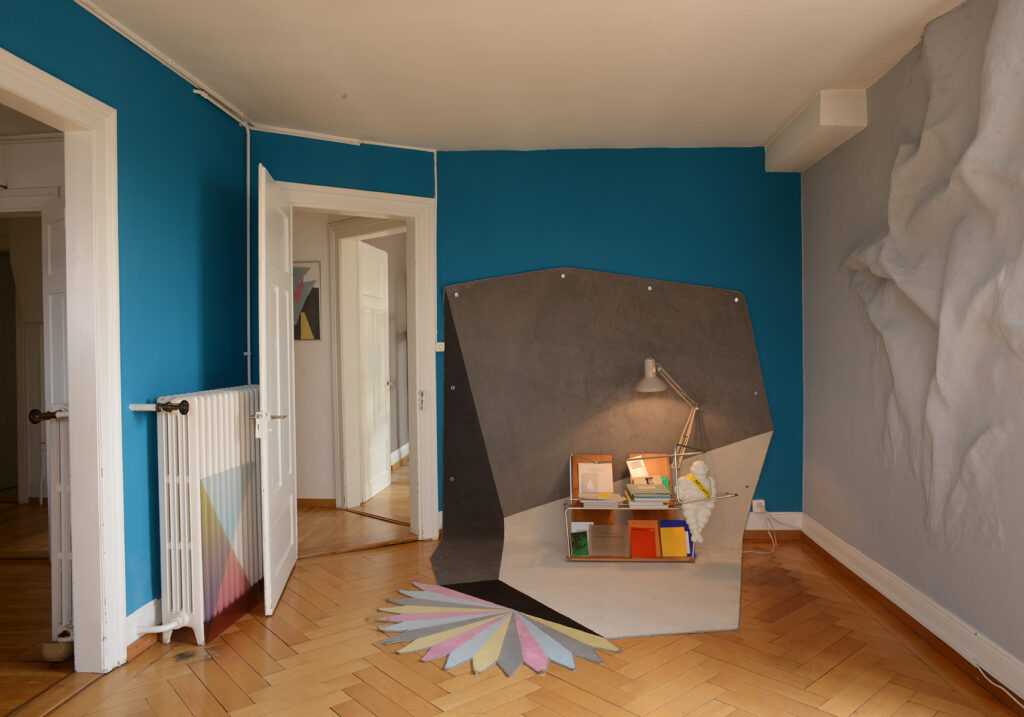
Davide Cascio and Oppy De Bernardo are the featured artists in the sixth issue of Wohung. Davide Cascio’s installation in the salon uses salvaged structures that were originally archival devices in the 1950s for hanging files. The artist repurposes their form and function, turning them into display units for a selection of books chosen from the library.
A geometric work is created by collaging carpets of different colors, its shape referencing Dürer’s Melancholy. The installation transforms the living room into a reading space while also sculturally engaging with the architecture of the room.
ISSUE #7
THOMAS BONNY, OLIVER ROSS
The artist Oliver Ross intervenes in the kitchen and dining room with a filter coffee machine that literally infiltrates the spaces, passing through the walls to return to the kitchen in an absurd, endless circuit. What is usually a domestic, comforting ritual becomes a looping system without origin or end: coffee flows, disappears into the architecture, and re-emerges elsewhere, as if the house itself were digesting its own habits.
Time repeats itself, day after day—the eternal return and Sisyphus chasing one another through silicone tubes salvaged from a pharmaceutical laboratory. The installation functions like a digestive apparatus, but one that processes not only coffee, ash, and residue, but also routine, memory, and the weight of repetition embedded in everyday gestures.
ISSUE #8
Tobias SPICHTIG & PAOLO THORSEN-NAGEL
ISSUE #9
LUC MATTENBERGER
ISSUE #10
MARCO FEDELE DI CATRANO, PASCAL SCHWAIGHOFER