EXHIBITION/ MORE WINDOWS
PARTNER/ LES URBAINES
abstract/ A project questioning the permanent state of crisis, its tensions and implicit effects.
LOCATION/ LAUSANNE, 2012
STATEMENT
Les Urbaines is a festival with a youthful, cross-disciplinary attitude. Until now, the programme, which touches on different levels of contemporary culture, had sought to develop a specific level for contemporary art and, in collaboration with independent spaces active in the Lausanne area, gave rise to an exhibition spread over several venues.
From this year onwards, a new attitude is taking shape, with most of the artistic interventions contributing to a dynamic itinerary that increasingly exploits the public space and the relationship with the city. The programme is presented not as an open-air art exhibition, but as a constellation of heterogeneous positions, or a series of windows that open onto a dilated temporality, revealing here and there the possibility of a different way of looking at the city, at the dynamics underway, which are slowly transforming the structure and fruitfulness of a district like Sévelin.
The utopian spirit, which can still characterise an artist's work today, becomes here the site of a paradox, an echo that reaches out to us from afar and speaks to us of our shared experience and notion of time.

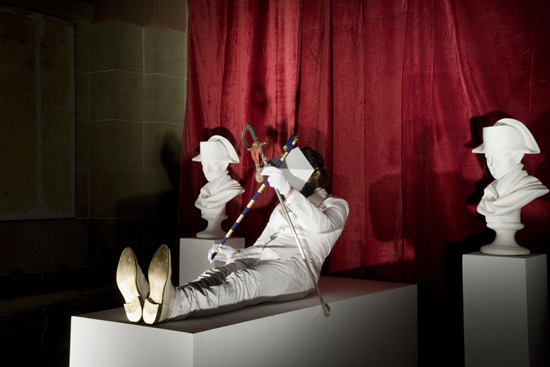
The utopian spirit, which can still characterise an artist's work today, becomes here the site of a paradox, an echo that reaches out to us from afar and speaks to us of our shared experience and notion of time.
The works and happenings of the various artists remain independent, yet work together to instil in the viewer a strange sense of aporia, where time assumes a random character (Kerim Seiler, Luc Mattenberger, Lasch/Ponn, Dragana Sapanjos), fantasy and incontinence take precedence over the functions of a place or an institutional status (Oppy De Bernardo, Christopher Füllemann, Billari, Roaming, Oliver Ross).
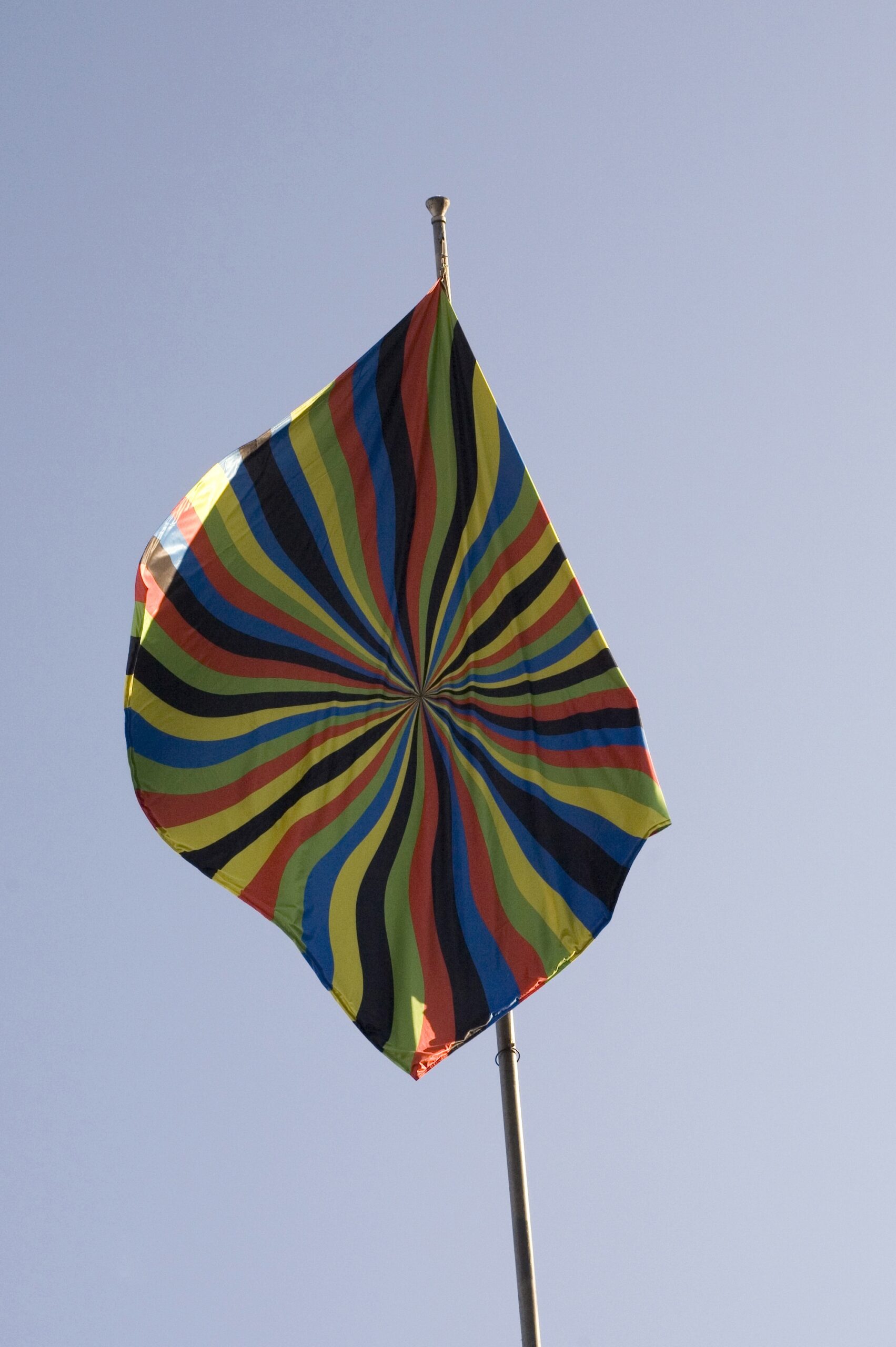
The ritual of everyday life connects with the spirit by touching on the deepest roots of our society, with worship and litany (Luigi Presicce, Eggerschlatter), while the notion of the representation of an unknown and distant reality approaches the banality of the near and known (Carlos Casas).
The main setting for this programme is the industrial district of Sévelin, one of the areas most sensitive to the urban transformation under way. However, utopia is not the theme here, but is simply applied by the artists' interventions to a particular context, which is the very subject of our research.
The Sévelin district offers a number of examples of heterotopia, with wastelands, disused factories and signs of gentrification superimposed in a wide-ranging stratification on other, less recent signs that are part of a different history. The disappearing industrial history speaks to us of a global situation, which is nothing new, but it is still a recent history whose disappearance carries with it consequences that risk projecting us back into the past; whereas the recent histories seem to want to speak to us of a near future where each function and each activity has its precise place, its reference image. As was the case for the adjacent Flon district, Sévelin is changing rapidly.
Today, in the same context, there are administrative offices, numerous schools, the Sévelin theatre, a waste disposal site, the Arsenic theatre, a skate park, a design shop, a bar and numerous offices of independent operators. We are interested in this state of great latent potentiality, in which commercial and projectual interests coexist, in which everything is still possible and achievable. The idea here is to reinforce a feeling that everyone can understand and hear, of a dilated time that is coming to an end and at the same time reproducing itself in a perpetual loop.
PARTICIPATING
ARTISTS
DOMENICO
BILLARI
The artist confides his childhood dream to the audience, whom he enlists to help him realise it. This weightless storyteller takes flight in the lobby of the Cantonal Museum of Fine Arts, spurred on by spectators encouraged by his humour and equally light-hearted spirit.
In his English tinged with an Italian accent, he poses simple questions, challenging each person's boldness in the face of their own dreams. He leaves the ground to the childlike wonder of the audience and falls gently back down, certain that it is possible to make dreams come true.
LASCH &
PONN
Doris Lasch and Ursula Ponn work on the status of the work of art. Their approach is narrative, with the work being presented as a document. The starting point may be a real situation, as is the case for the project developed as part of Les Urbaines.
The two German artists refer to the architectural similarities between the spaces of the Lucy Mackintosh Gallery and those of the Museo della Civiltà Romana in Rome, where 500 crates containing archaeological artefacts have been stored, in some cases since the end of the 19th century, without anyone knowing their contents.
CARLOS
CASAS
Filmed in the extreme peripheries of the civilised world – from Tierra del Fuego in Patagonia to Siberia and from Karakalpakistan to the Tundra – Carlos Casas' films question the archetypes of civilisation itself, reduced to its bare essentials, where humans live in environments with scarce resources.
More than a documentary record, the author strives to capture the strength of these isolated communities' survival through a respectful immersion in their rhythms and rituals. The care taken in editing and sound design make this a work that transcends the ethnographic approach.
DRAGANA
SAPANJOS
The Croatian artist works on the limits of what is bearable and disturbing dynamics. Through installations and radical scenarios, she establishes close contact with the viewer, who becomes, through their presence and perception, an integral part of the work.
A game develops between the audience and the artistic intervention, arising from the juxtaposition between knowledge of social codes and fundamental ignorance in situations that require specific mastery. Dragana Sapanjos takes over the concrete labyrinth that is the Arsenic shelters, contrasting the military imagery of the bunker with that of pop music.
Christoph
Füllemann
The exotic forms that emerge from Christopher Füllemann's sculptures are the result of a hybridisation between the organic and the inorganic, between an enchanted world and another that is more monstrous, even grotesque. Thanks to its unique location, the boules court on Rue de la Vigie has been transformed into a platform for the presentation of a new temporary sculpture by the artist.
The strange spatial dimension of this space, somewhere between public and private, as well as the possibility of experiencing the work from several different angles, accentuates its wild character and contrasts with the static idea of a public monument.
OPPY DE
BERNARDO
During the three days of the festival, the Chauderon Bridge is decorated with thirty-six brightly coloured flags. While their appearance may evoke popular imagery associated with alternative culture and social and political movements, they actually have a much more institutional origin.
The motif chosen by the artist is in fact the result of a hack based on one of the earliest versions of the Swiss Guard flag. During the slow formation of the Confederation in its current form and the development of a sense of national identity, this flag served as a precise barometer of the geopolitical balance that Switzerland was forging with other countries.
KERIM
SEILER
A globetrotter, sculptor in the classical sense of the term, architect in the design of the structures that give rise to his works, child of '68, psychedelia and concrete art, Kerim Seiler is an artist who does not seek to assert his work through a concept, but through an empirical practice of transforming acquired forms.
His nomadic spirit and references to other cultures reveal a visionary and eclectic attitude, gifted with synthesis and transversality. He has designed a luminous sculpture on the roof of Eracom that resembles a digital clock and conveys a reading of time according to a random coding system.
LUC
MATTEN-BERGER
Through their use of organic materials (resins, cement, acids), the sculptors Nicola Martini and Vittorio Cavallini are interested in matter and more particularly in the elementary processes of sculpture: those that we observe, those that we only grasp intuitively.
During Les Urbaines, they will be accompanied by musician Attila Faravelli. Their headquarters will be in the fourth basement of the Place de la Riponne car park, the only place in Lausanne where you can see the River Louve and have direct access to the sewers.
LUIGI
PRESICCE
Through his performances, Luigi Presicce stages rituals, tableaux vivants and secular cults. Appropriating religious, occult and popular symbols, the artist creates a hybridisation of these beliefs and searches for a common root that gives rise to a renewed sense of metaphysics.
During Les Urbaines, he takes over the Guillaume Tell Chapel, donated to the City in 1917 by a French patron named Osiris, a bourgeois monument symbolically dedicated to a hero celebrating patriotism and a certain idea of power.
OLIVER
ROSS
Each of Oliver Ross's creations appeals to both the senses and the psyche, unfolding in a profusion of colour, a dense and overflowing amalgam through which the artist invites us to view the world.
Like an alchemist, he obsessively assembles textures borrowed from everyday consumer products, whose formal properties become the objects of a process of organic revitalisation. Through pseudo-scientific experiments, these elements are transformed into a ‘decor-active’ fluid and together compose a hallucinatory Gesamtkunstwerk.
MINIMETAL
Visual artists and musicians Nik Emch and Laurent Goei create performances they call ‘sound sculptures’. They develop highly aesthetic scenographies using video and sculpture, which they combine with live music in an ‘underground punk’ spirit.
Their metal, reminiscent of post-rock and influenced by Kyuss, Black Sabbath, the Stooges and the Velvet Underground, blends with a flood of images in a dizzying and aggressive atmosphere. Minimetal mixes art and punk with an avant-garde attitude while preserving the dark romanticism of metal.
EGGER/
SCHLATTER
Journey through the city of Lausanne from Sévelin
Sabine Schlatter and Benjamin Egger draw on disparate popular customs and counterculture aesthetics to create happenings in the form of rituals and gatherings.
A tourist train decorated with garlands of flowers, connecting the various festival venues, broadcasts a litany composed for the occasion and performed by a flamenco singer. The public is invited to embark on an ambiguous procession that conveys a utopian vision of cultural aggregation.