EXHIBITION / OPEN HOUSE
abstract / An exhibition showcasing housing concepts from art, architecture, design
and humanitarian
projects.
LOCATION / GENEVA, 2022
STATEMENT
Open House is a series of exhibitions and events conceived and directed by Simon Lamunière and presenting innovative and original forms of habitat through projects in the fields of art, architecture, design and humanitarian aid.
It took place in four phases between May 2021 and August 2022. The last and most important of these events brought together 35 projects and pavilions in Geneva's Parc Lullin during the summer of 2022.
The main aim of the exhibition was to broaden thinking about the concept of habitat. The programme focused on radical and original innovations in architecture, art, design and humanitarian issues.
It also stimulated reflection on migration policy issues, highlighting how mobility issues are redefining living spaces and requiring far-reaching revisions to our concepts of habitat and solidarity, taking account of environmental and social challenges.

PARTICIPATING
ARTISTS
ANNEX
GROUND WORK
In 1958 in Zurich, the second national Schweizerische Ausstellung für Frauenarbeit (SAFFA) or “Swiss Exhibition of Women’s Work” was mounted by several women’s groups. It aimed to raise awareness of the importance of women’s work and encourage their advancement.
For the event, the Swiss architect Berta Rahm deployed the large easy-to-disassemble pavilion of the Milanese architect Carlo Pagani and designed a small annex. The latter, rediscovered in the spring of 2020, is one of the rare pieces that have come down to us from SAFFA 58 and the body of work by one of the first female architects in Switzerland.
For Open House, Annexe has created a brick floor that matches the same surface area as the original annex but in the shape of a circle that fits nicely into Lullin Park. The spaces are indicated by the differences in the bricks’ composition.
ATELIER VAN
LIESHOUT
Drop Hammer House
JOËLLE
ALLET
Cloud
MONICA URSINA
JÄGER
Homeland Fiction (a constellation)
CATTELAN &
PARRENO
Dolce Utopia
FABRICE
GYGI
Table-tente
FREEFORM
TENTS
MANTA
Tents have always been temporary shelters. They make it possible to organize military campaigns or respond to humanitarian emergencies, sheltering refugees, sometimes the homeless in our cities, or makeshift hospitals.
A young firm that first took shape in 2003 in South Africa, Freeform readily confesses that Bedouin tents woven from goat hair and used on the other side of the continent served as inspiration for the stretchable multipurpose tent of today. This reinvention of a centuries-old technology has proven an unmatched tool for our century of event planning.
The firm has developed a standard range that allows people to create spaces that cover from 20 m2 to 600 m2 by grouping a series of canvases as need be.
FRIDA
ESCOBEDO
SYSTEM_01
Frida Escobedo has endlessly crossed back and forth over the bridges between architecture, design, and art, changed scales and mediums, and dominated the simplicity of materials as much as the potential of the motif – all accomplished while remaining true to Mexican modernism.
The architect is especially interested in creating public cultural spaces that teach us how to live together and better manage the friction that arises from a life in common.
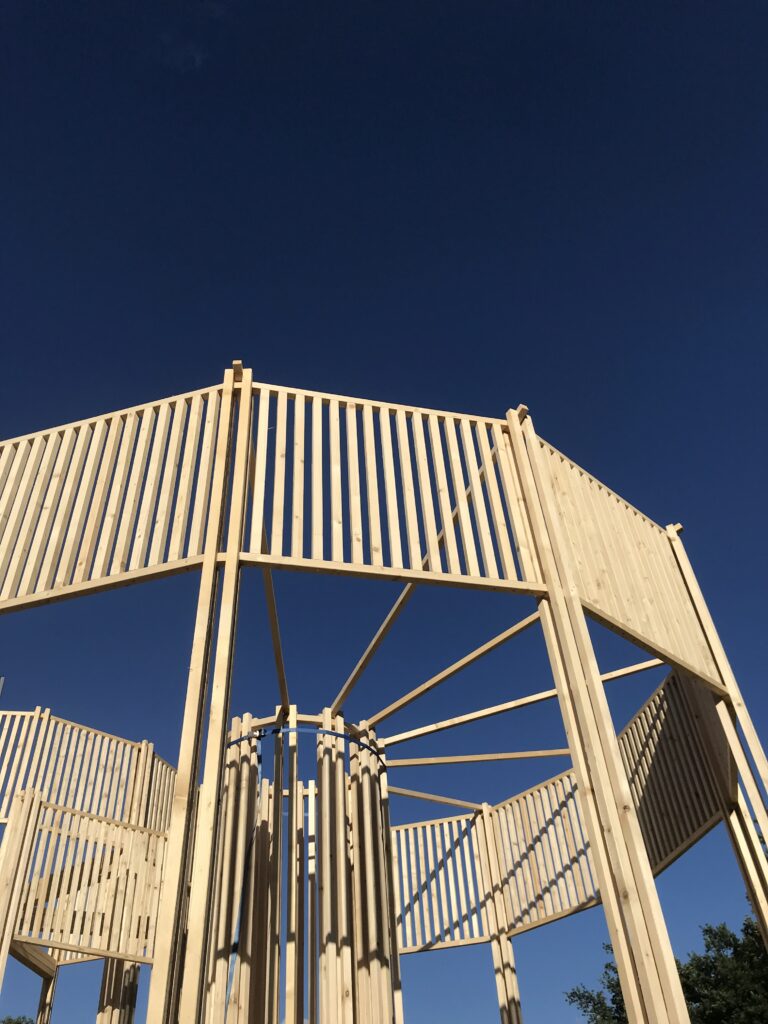
In the early stages of the circular constructions built in Lullin Park, she mentioned the archeological sites of Stonehenge, the tepees of the Great Plains Indians and the huts of lake-dwellers.
Coproduction Open House Geneva and 90_20.
JOHN
ARMLEDER
UNTITLED
From the 1980s onwards, with the Furniture-Sculpture series, he focused on the reuse and juxtaposition of everyday objects, mixing readymades and paintings by integrating them into the exhibition space, which it self ultimately becomes the work, to be seen as a whole.
The chair, itself a recurring theme in 20th-century art, is presented in this exhibition perched a top a tree. Like an outgrowth of the tree, the saddle is detached from its function and ironically shown to the visitor in a quintessence of anti-utilitarianism.
In 1985, John Armleder featured in the exhibition Promenades, curated by Adelina von Fürstenberg in the same park as today. With their agreement, Open House directly alludes to that exhibition, which is when the artist first showed his chairs placed high up in the trees.
LANG /
BAUMANN
UP #5
The structure set up in the grass of the park seems to take the title Open House literally. It has the size and the minimalist lines of a house, or part of a building, on two levels. And it is wide open to the four winds. But it is uninhabitable because it leans lopsidedly due to the absence of one its supporting walls.
The pure form of this object seems to be in keeping with the L/B that has been the common signature of Sabina Lang and Daniel Baumann. Space and its aesthetic experience have always been part of their work.
EDUARD
BÖHTLINGK
De Markies
DIDIER
fiúza FAUSTINO
A Home is not a Hole
KEN
ISAACS
Fun House
MATTI
SUURONEN
Futuro HOUSE
CARLA
JUÇABA
Fil d’air
ANUPAMA
KUNDOO
Power House
MARCEL
LACHAT
Soeur de la Bulle Pirate
ICRC
Homeland Fiction (a constellation)
ANDREAS
KRESSIG
Envelop
FIONA
MEADOWS
La maladresse d’une boîte à lettres
SHELTER
PROJECTS
Relief Housing Unit
Shelter Projects is a humanitarian consortium aiming to support self-help shelter for populations affected by disasters and conflicts. While bearing in mind the limits on resources, the aim is to identify the types of aid that are useful rather than to define the needs and accommodation of refugees in an authoritarian manner. Durable solutions are to be found less in architectural conceptions than in the empowerment of the populations concerned.
In the event of a humanitarian crisis, Shelter Projects aims to provide a minimum of 3.5 m2 of living space per person. Unfortunately, this minimum space is not always available. For Open House, they are proposing a radical and symbolic gesture by exposing the bare earth on a plot measuring 17.5 m2, the surface area for a group of five people.
NICE & WISE
STUDIO
ECOCAPSULE
The Ecocapsule is a creation of Nice & Wise, an architectural and design studio based in Bratislava. Its eggshell design and the various integrated functionalities make it a self-sufficient tiny house. It offers the comfort of a hotel room for two people without the constraints of construction, and its relatively lightweight of 2 tonnes allows it to be transported anywhere.
STUDIO ZELTINI
Z TRITON
Zeltini is a design studio based in Smiltene in northern Latvia. Aigars LAUZIS founded it in 2018. The Z-triton is conceived as a multi-purpose means of transport that combines a spare shelter, adapts to land travel, and has an amphibious option to navigate inland waters.
One of Zeltini’s objectives is to provide a practical, fun tool, and above all, one that minimises the environmental impact it may cause.
Their designs are ethical, innovative, and creative.
The Z-Triton is an amphibious vehicle combining a boat equipped with a motorised propeller and an electric bicycle. The interior space is designed for two people and, thanks to its modular equipment, allows for sleeping, eating, or sheltering in case of bad weather. The roof is equipped with solar panels to power the electrical system and a compartment for growing plants.
ANGELA
LUNA
THE TRENCH
This jacket was created in 2016 by Angela Luna after she became aware of the extent of the social and humanitarian crisis.
She realised that donated clothing does not always correspond to local needs.
She proposes a thoughtful design for a humanitarian application to clothing with her creations, whose form follows function. The trench coats are one size fits all, contain pockets for storage, are waterproof and insulating, and can be converted into a tent for mobile living.
Through this hacking of the fashion industry, ADIFF is redistributing a trench coat/tent to a homeless person for every purchase on their website in a one-buy-one-give system. This initiative has already resulted in over a thousand tents and nearly $80,000 to its employees.
GRAMAZIO
KOHLER
SArchitecture For Degrowth
For the Gramazio Kohler Research Group at ETH Zürich, the processes involved in digital architecture influence both the conception of the design and its practical implementation.
Recycling concrete, recycling building modules that have no place in another building, rather than constructing a temporary pavilion, is their proposal for an “open house,” built in different phases from concrete scraps.
With their particular structure and texture due to the method of creation by 3D printing, these objects will be the visual clues of an imaginary but still present and evolving space that the public will discover throughout the summer.
UNHCR
REFUGEE HOUSING UNIT (RHU)
The Refugee Housing Unit (RHU) is an innovative housing solution developed through a collaboration between Better Shelter and UNHCR, with the support of the IKEA Foundation. The partnership was created to create a safe and dignified shelter for refugee and displaced populations.
The RHU was developed after various tests in the laboratory and on the ground, in different climatic conditions, and after consultations with universities and refugee communities.
Since then, more than 60,000 units have been deployed in more than 50 UNHCR centers worldwide. Feedback from the people affected has been highly positive, highlighting the role of the RHU in improving their lives.
RAHBARAN HÜRZELER
ARCH.
The Modulora Prototype
KERIM
SEILER
Tender is the Night
RELAX
SNAIL SHELL SYSTEM
UNA
SZEEMANN
A Ruin for Fossils
VAN BO
LE MENTZEL
REFUGEE HOUSING UNIT (RHU)
ANDREA
ZITTEL
A-Z Escape Vehicle
N55
Snail Shell System
The N55 group, co-founded in 1996 by Ion Sørvin and Ingvil Aarbakke, comprises several artists and designers.
The Snail Shell System, a temporary and modular mobile habitat, is developed with a focus on adaptation; it can be used as an emergency shelter, as a raft, or even as a stock of commodities.
The idea behind the Snail Shell System is based on the hypothetical, on the possibilities that this habitat can offer both in its function and mobility.
Indeed, the capsule can be moved on land as well as on sea; a paddle is provided for navigation.
The unit is modular to adapt to various situations.
EPFL
BECOMING LéMAN
BECOMING LÉMAN
EPFL LABORATOIRE ALICE
ALICE is an architecture laboratory at the École Polytechnique Fédérale de Lausanne. The laboratory has based its pedagogy on concrete practice in the form of “Houses”, a program in which students go through all the different phases of architecture.
Since 2018, the ALICE laboratory has embarked on a new educational project, BECOMING LEMAN, which aims to make Lake Geneva and its surroundings a laboratory where to collectively and globally rethink the relationship between human society and its environment. It is part of a local approach, but also of a regional and cross-border dialogue.
The project realized for Open House during a semester in 2021 took place at the Bains du Saugy and involved a pedestrian extension over the water, a large staircase down to the lake and mobile floating elements.
TENTSILE
Connect classic camping stack 3.0