RESEARCH/ ATLAS ARCHIPELAGO
abstract / A PALIMPSEST ON ART, ARCHITECTURE, POLITICS, MYTHOLOGIES, HISTORIES
AND EVIRONNEMENTS.
A research project exploring the underlying potential architectures that intuitively shape knowledge.
NETWORKS OF
knowledge
COMPLEXITY
Complex thought is based on the idea that reality cannot be understood through fragmented or reductive approaches. It asserts the necessity of connecting what is separated, holding together heterogeneous dimensions—scientific, philosophical, cultural, and subjective—and accepting uncertainty, contradiction, and interdependence as fundamental components of knowledge.
From this perspective, breaking down the barriers between fields of knowledge becomes essential in order to move beyond closed disciplinary logic and to foster transversal exchanges. This interrelation of knowledge makes it possible to better grasp the complexity of the contemporary world by integrating the interactions between parts and wholes, and by opening the way to a more dynamic, critical, and creative understanding of phenomena.
As Edgar Morin states in one of his essays «terrestrial identity and anthropolitics cannot be conceived without a way of thinking that is capable of connecting disjointed notions and compartmentalized knowledge.
Earth is not the sum of a physical planet plus the biosphere plus humanity. The Earth is a complex physical-biological-anthropological whole, where Life is an emergence from the history of the Earth, and man is an emergence from the history of terrestrial life. Man’s relationship with nature cannot be conceived in a reductive or disjointed way. Humanity is a planetary and biospheric entity. Human beings, both natural and supernatural, must be sourced in living, physical nature, but they emerge from it and are distinguished from it by culture, thought, and consciousness.
Fractional thinking, which fragments what is global, inherently ignores the anthropological complex and the planetary context. But it is not enough to wave the flag of globalism: the elements of globalism must be brought together in a complex organizer, this global concept itself must be contextualized. The necessary reform of thinking is one that will generate a way of thinking about context and complexity.
There is a need for a way of thinking that connects what is disjointed and compartmentalized, that respects diversity while recognizing unity, that tries to discern interdependencies,
radical thinking (which goes to the root of problems),
multidimensional thinking,
an organizational or systemic way of thinking that conceives of the whole/parts relationship—as it began to develop in ecological and Earth sciences,
ecological thinking that, instead of isolating the object under study, considers it in and through its self-eco-organizing relationship with its cultural, social, economic, political, and natural environment,
thinking that conceives of the ecology of action and the dialectic of action, and is capable of a strategy that allows the action undertaken to be modified or even canceled,
a way of thinking that recognizes its incompleteness and negotiates with uncertainty, particularly in action, because action can only take place in uncertainty.»1
1. Edgar Morin, Vers l’abîme?, Paris, L’Herne, 2007.
ARCHIPELIC
Thinking
Through archipelic thinking we can know the rocks of the smallest rivers for sure and envisage the water holes they cover where freshwater crayfish still shelter. The phrase act in your place, think with the world is now widespread. It can be found on the walls of the largest cities as well as on the traces of abandoned villages. With this remarkable injunction not to think in the world, which could reinvent the idea of conquest and domination, but to think with the world from which all sorts of relations and equivalences blossom.
First of all, place is inescapable because no one lives in suspension or dilution in the air, but also because I can never go around my place, contain it, bypass it, i.e. enclose it. The imaginary of my place is connected to the reality of all the places in the world. The archipelago is the image from which this imaginary arises. The scheme of belonging and relationship at the same time.
The archipelago is diffracted. We would go so far as to say with the practitioners of the chaos sciences that it is fractal. Necessary in its totality, fragile or possible in its unity. It is a state of the world.1
1. Édouard Glissant,
Tout-Monde,
Paris,
Gallimard, 1993
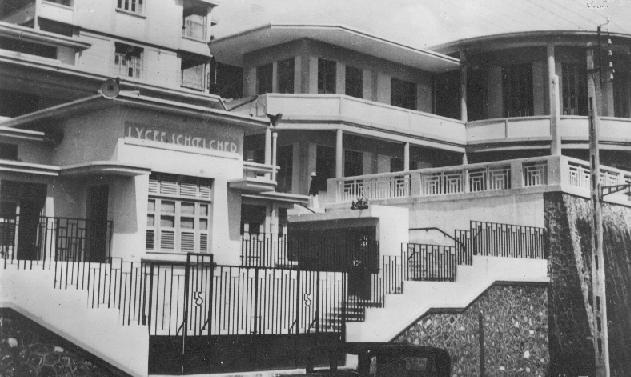
Lycée Schoelcher
Fort-de-France, Martinique
1. ATLAS
ARCHIPELAGO
INTRODUCTION
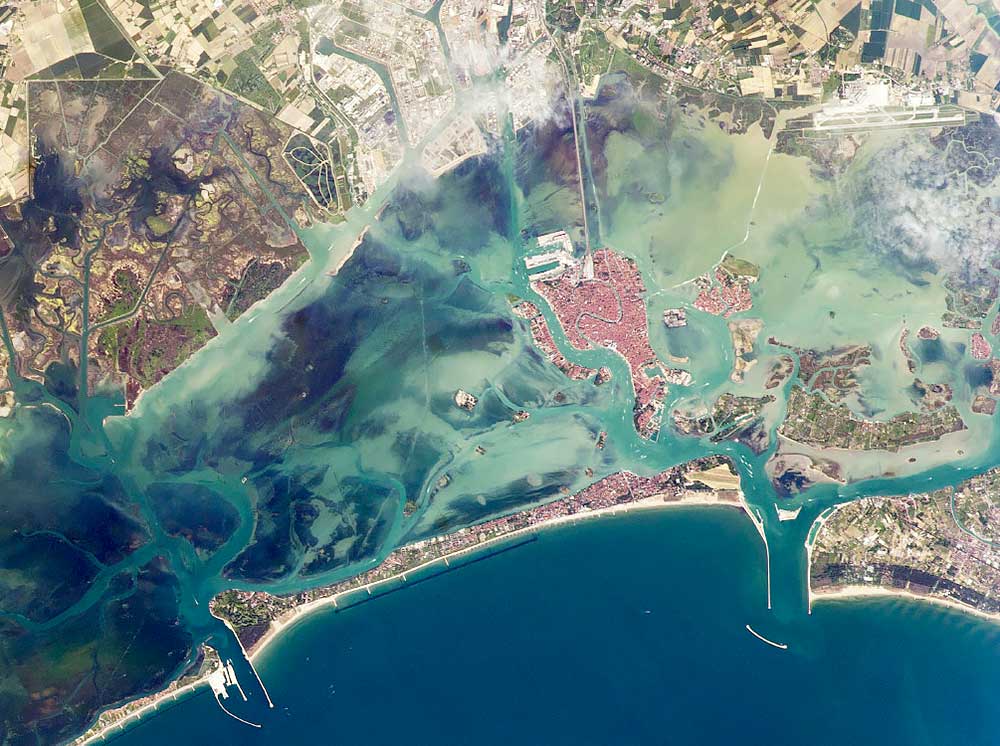
ATLAS ARCHIPELAGO is a research project structured and developed through a set of essays that touch on issues such as art, architecture and the environment. Through an approach that fluctuates between creative writing and non-fiction, which is deployed through multiple references and free associations between real and fictional facts, historical and cultural events, the discourses will develop ramified reflections and raise relevant issues related to contemporary culture and society.
Inspired by real and natural events, historical and cultural figures, ghostly architectural structures or unrealized projects, related to the history of Laguna, the discourse will develop into a kind of conceptual atlas. An imaginary anthology, a conceptual apparatus, which structures reflections that go beyond the specificities of a place to outline the possibilities of a global cartography.
Taking as a starting point the particular morphology of the intertidal zones that characterize the landscape and the ecosystem of the Venice Lagoon, the various essays will develop around the notion of specter, phantom entity, moments of absence that float and fluctuate through different and deferred temporalities and spaces.
The research is developed keeping in mind the fragility of the lagoon ecosystem whose challenges clearly echo the global climate issues, the considerations concerning the urbanism and architecture of the contemporary city facing the need for a sustainable development as well as the fundamental role of contemporary culture in the formulation of a global collective consciousness.
Starting from an island geography and extending to an archipelago, the texts will develop in the form of wanderings between land and sea, architecture and nature, art and urbanism, shadows, histories and discoveries.
From the changing and fragile morphology of the Barene to the Cyclades archipelago mentioned in a letter written by Cassiodorus in the 6th century, sailing towards the Maledives Pavilion and Edouard Glissant’s archipelagic thought.
Following the course of the Sardone, juvenile and seasonal marine migrant in the Venetian Lagoon, the discourse will develop through the opening of a navigable canal of Malamocco, while going back in time to follow the deviation of the Brenta and the disappearance of the legendary Metamauco, a sort of Mediterranean Atlantis.
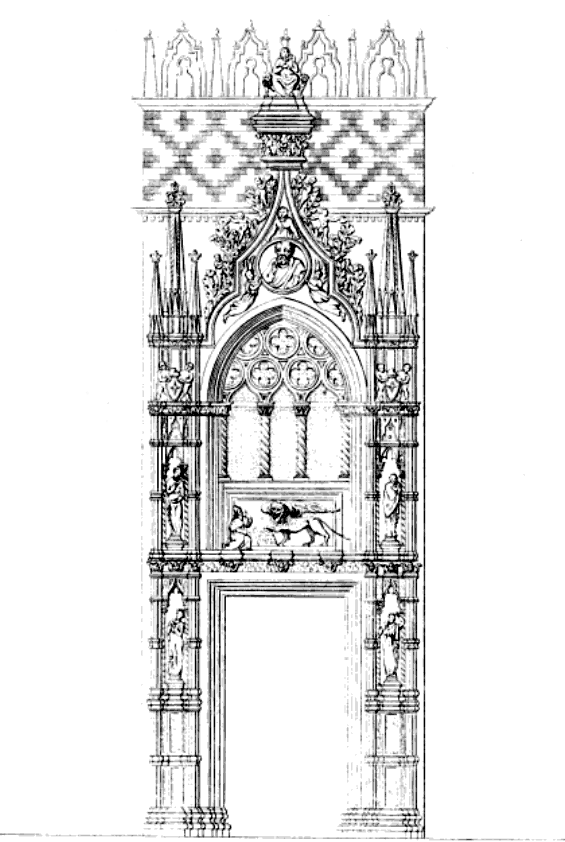
Engraving from:
'The Doge’s Palace in Venice'
illustrated by
Francesco Zanotto, Venice 1841
The disappearance and ghostly presences also appear in the case of Carlo Scarpa’s Book Pavilion, where the clearly Wrightian inspiration will naturally lead us to Wright’s unrealized work for the Fondazione Masieri in Canal Grande.
From the largest covered car park in Europe until the 1950s, built by Eugenio Miozzi in Piazzale Roma, to Le Corbusier’s unrealized project for the Hospital of Venice and his famous metaphor of the machine-à-habiter.
The idea behind this research is to reveal some
micro histories and extend them in a global perspective inspired by the historical, social, economic, natural and cultural context of Venice. Because of its history, its strategic position between East and West and its fragile ecological balance, its colonial ambitions, Venice embodies the starting point, the city-labyrinth, the city-world whose aura and emergence go far beyond its local borders and reach global questions.
MASTERS OF
THE CYCLADES
According to the first known description of the Venetian lagoon, contained in the famous letter of Cassiodorus, addressed in 537-538 to the maritime tribunes, the Venetian region, dotted with islands, resembled the Cyclades. “Here”, wrote the powerful prefect of the Praetorium in his letter, “your house is made like that of the waterfowl, for what is now land sometimes appears to be an island, so much so that one believes oneself to be in the Cyclades when one suddenly sees again, unchanged, the aspect of the place1 “.
In the following centuries, the descendants of these lagoon populations succeeded, through a series of historical events, in creating the Serenissima Republic of Venice, one of the great medieval economic powers of the West. Taking advantage of the pseudo-crusade of 1204, the Venetians occupied “a quarter and a half” of the Byzantine territories and settled in most of the Aegean islands.
Thus, by a quirk of history, the inhabitants of the city of St Mark became masters of the Cyclades, of those islands whose landscape, according to Cassiodorus, resembled their lagoon. However, to designate Venice’s colonial empire in the Aegean, Venetian documents paradoxically use the name Arcipelago instead of the Greek name Aigaion Pelagos, which became familiar to navigators and in general to all Westerners.2
1. ... ut illic magis aestimes esse Cycladas... : Magni Aurelii Cassiodori Variarum libri XII, cura et studio A. J. Fridh, Turnhout 1973 (Corpus Christianorum, Series Latina 96), pp. 491-492.
2. Chryssa Maltezou, De la mer Égée à l’archipel : quelques remarques sur l’histoire insulaire égéenne Chryssa Maltezou p. 459-467, Éditions de la Sorbonne, 1998.
Aigaion pelagos
"It is interesting to note that etymology shows us a strange reversal in the evolution of the word «archipelago». «Archi-pelagos» (Αἰγαίου Πελάγους) is Greek for the ancient sea or the sea par excellence; and perhaps the true etymology is, as Robert’s Dictionnaire historique de la langue française suggests, Aigaion pelagos, i.e. the Aegean Sea.
An archipelago is first of all a sea, - a sea dotted with islands (here continuity is emphasised), but the meaning has been turned around, since an archipelago is now considered rather a group of islands (emphasis on discontinuity).
The idea of an archipelago thus combines two contradictory notions: the isolation of the island and the connection of the whole. Hence the characteristics that Edouard Glissant gave to archipelago thinking in terms of ambiguity, fragility and drift."1
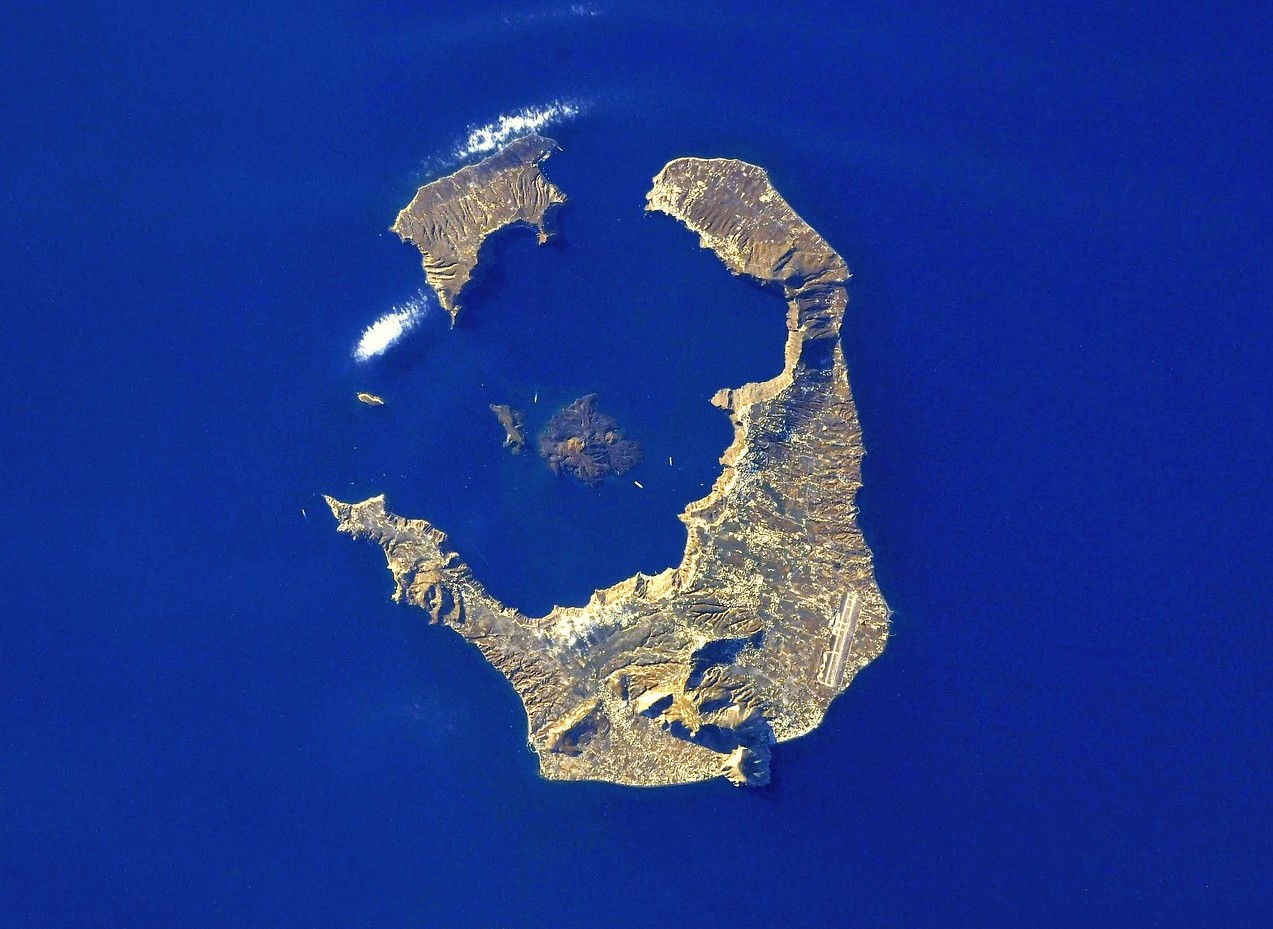
Santorini Island, Greece,
Seen From The ESA Space Station, 2022.
© ESA/NASA-S.Cristoforetti
THE REIGN OF
ATLAS
"Because there have been so many terrible cataclysms in these nine thousand years - because there are so many years between then and now - the part of the earth that in these years and in so many accidents has been detached from the heights did not accumulate sediments of earth of a certain consistency, as in other places and, sliding down in a continuous process all around, disappeared in the depths of the sea [...].
Poseidon, having conceived her desire, joined forces with Cleitus and fortified the hill on which she lived, making it steep all around, forming alternating smaller and larger sea and land enclosures, one around the other, two on land, three on sea [...]. He fathered five pairs of sons and gave them all names, and to him who was the eldest and king he gave this name, which is the name of the whole island and sea, called Atlantic because the name of the first to reign then was Atlas."1
1. Plato, Critias, 113 b and passim.
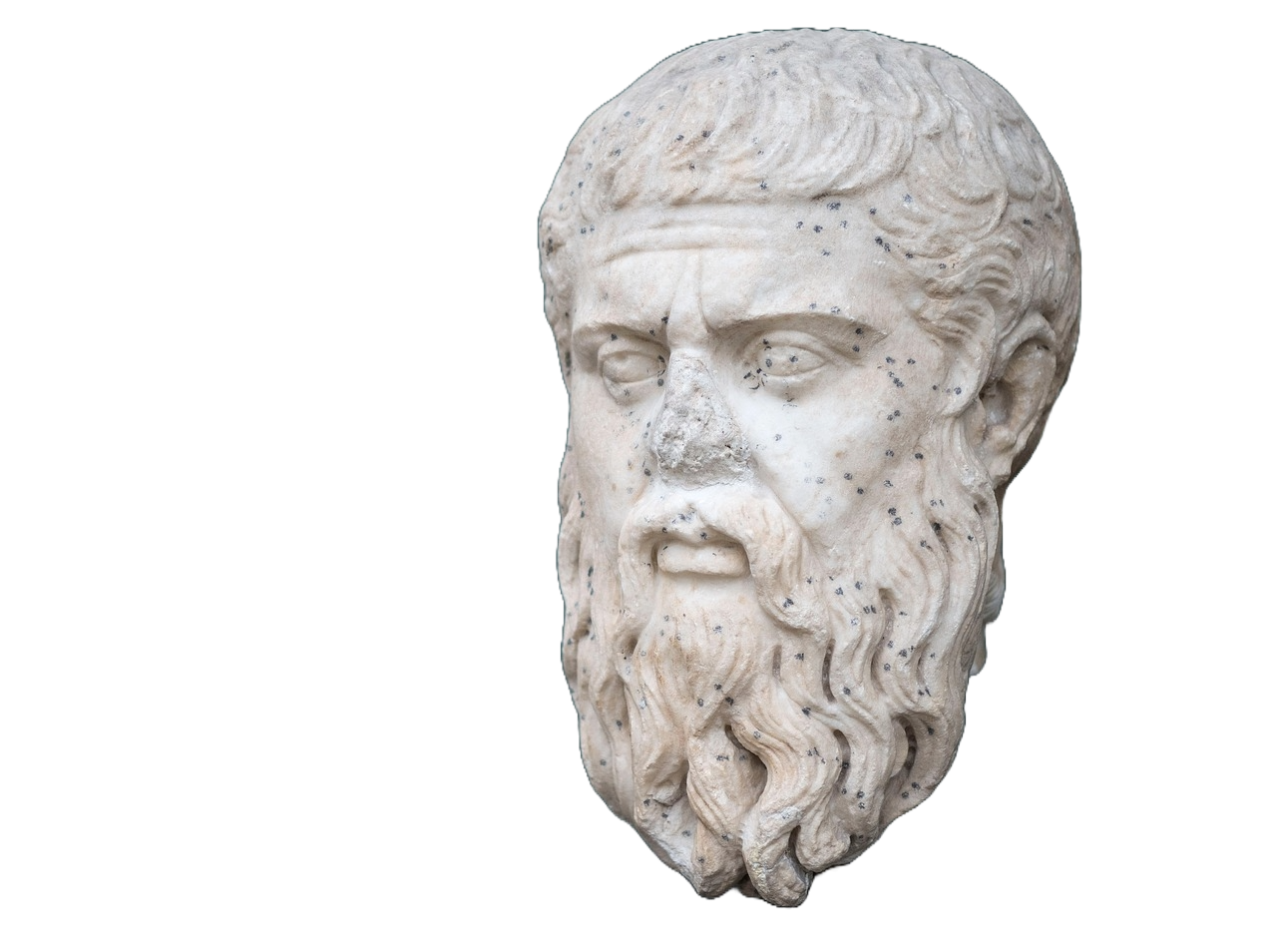
Head of Plato
Roman copy of Silanion's work, 370 BCE
Glyptothek, Munich
ATLANTIS
The myth of Atlantis is a legendary tale attributed to the ancient Greek philosopher Plato, originating from his dialogues "Timaeus" and "Critias." According to the myth, Atlantis was a vast and prosperous island ruled by the sea god Poseidon and his mortal wife Cleito.
The island featured a unique layout of concentric rings of land and water, with a grand palace at its center and was inhabited by ten rulers descended from Cleito's sons.
Initially, Atlantis thrived under a strict moral code and enjoyed great wealth and power. However, as time passed, the rulers became corrupt, seeking conquest over neighboring lands, which ultimately led to their downfall when they were defeated by the Athenians.
Following this defeat, Atlantis faced catastrophic natural disasters, resulting in its sinking into the sea. The myth of Atlantis has thus become a significant cultural reference, prompting various interpretations and speculations throughout history. 1
1. “Atlantis . . . Did Plato Know the Truth?” Monkeyshines on Mysteries in History, Ed. Phyllis Barkas Goldman, Greensboro: Monkeyshines, 2003. 40–41.
2.
APPEARANCES
The lagoon
The lagoon was fundamental to the rise of the Republic of Venice, providing protection from enemies and storm surges, strategic access to the sea and trade, and products such as salt and fish. In return, humans have intervened many times over the centuries to preserve the lagoon, even diverting the rivers that once flowed into it into the sea to prevent them from silting it up.
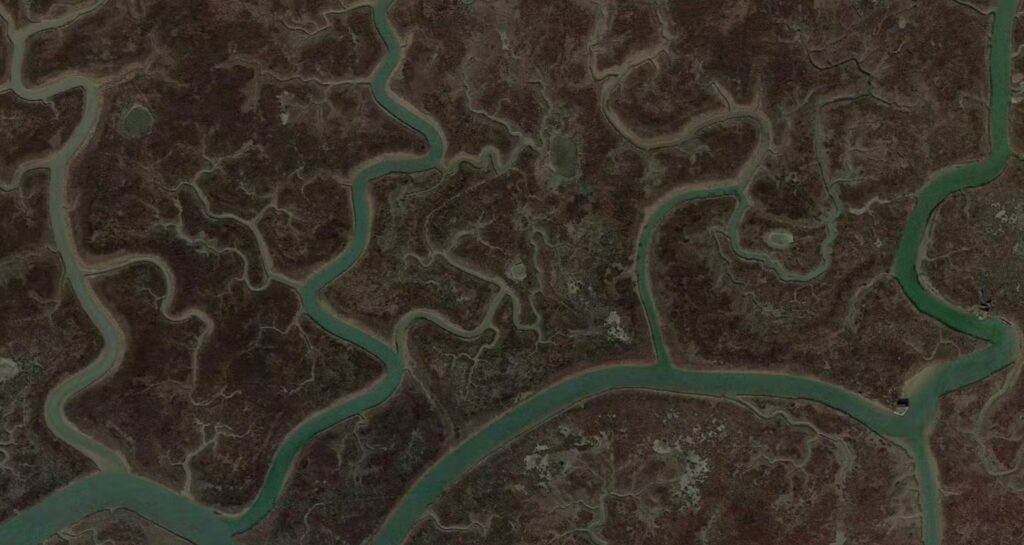
One of the most serious environmental problems affecting the Lagoon is the disappearance of its characteristic natural features, caused by widespread erosion that is emptying it of sediment. Due to erosion, the shallow waters of the lagoon are becoming deeper and flatter, and the salt marshes, one of the most precious environments in the Lagoon, are being consumed by currents and waves.
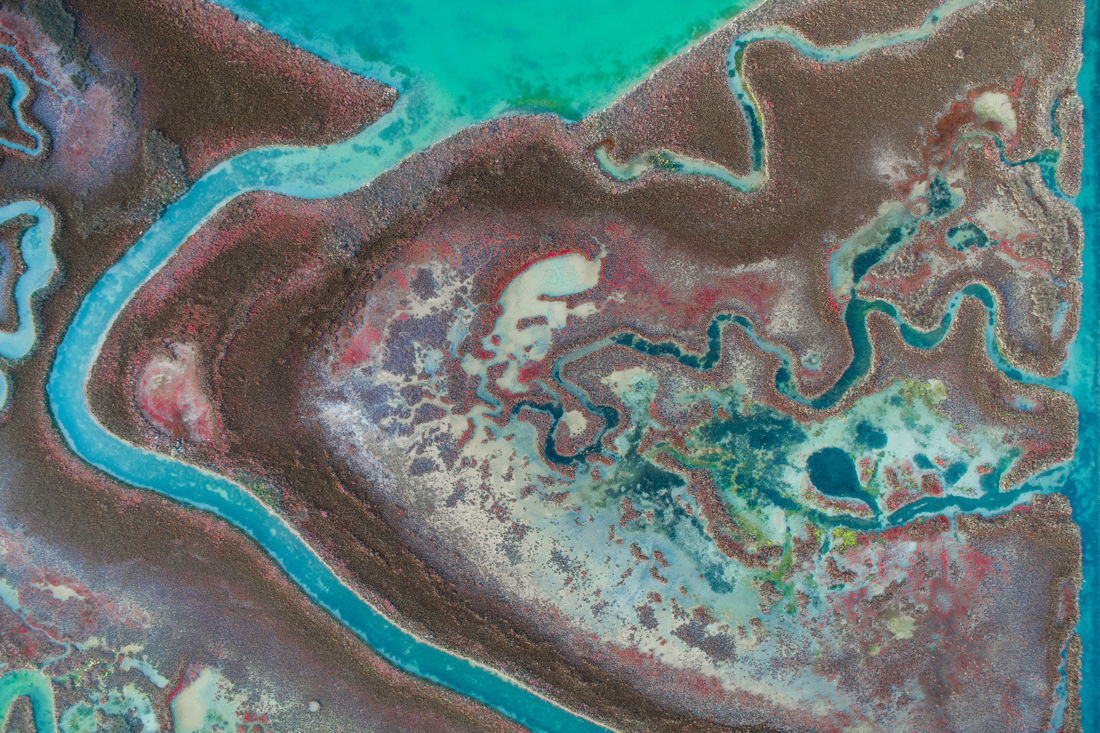
Riccardo Dell’Acqua,
I ghebi nella Laguna Nord di Venezia.
© Riccardo Dell’Acqua
DISAPPEARing
BARENE
THE BARENE (Salt marshes) are unique environments: these low-lying islets covered with grassy vegetation are found in an incredibly narrow altitude range (20 to 50 cm above mean sea level) and are periodically submerged by high tides.
They are home to special plants that can withstand fluctuations in salinity, temperature and tides, as well as numerous rare birds. Over the last century, the surface area of salt marshes has decreased by more than 70%, and with them, the incredible biodiversity of animals and plants that they host is also disappearing.1
1. Édouard Glissant,
Tout-Monde,
Paris,
Gallimard, 1993
TORSON
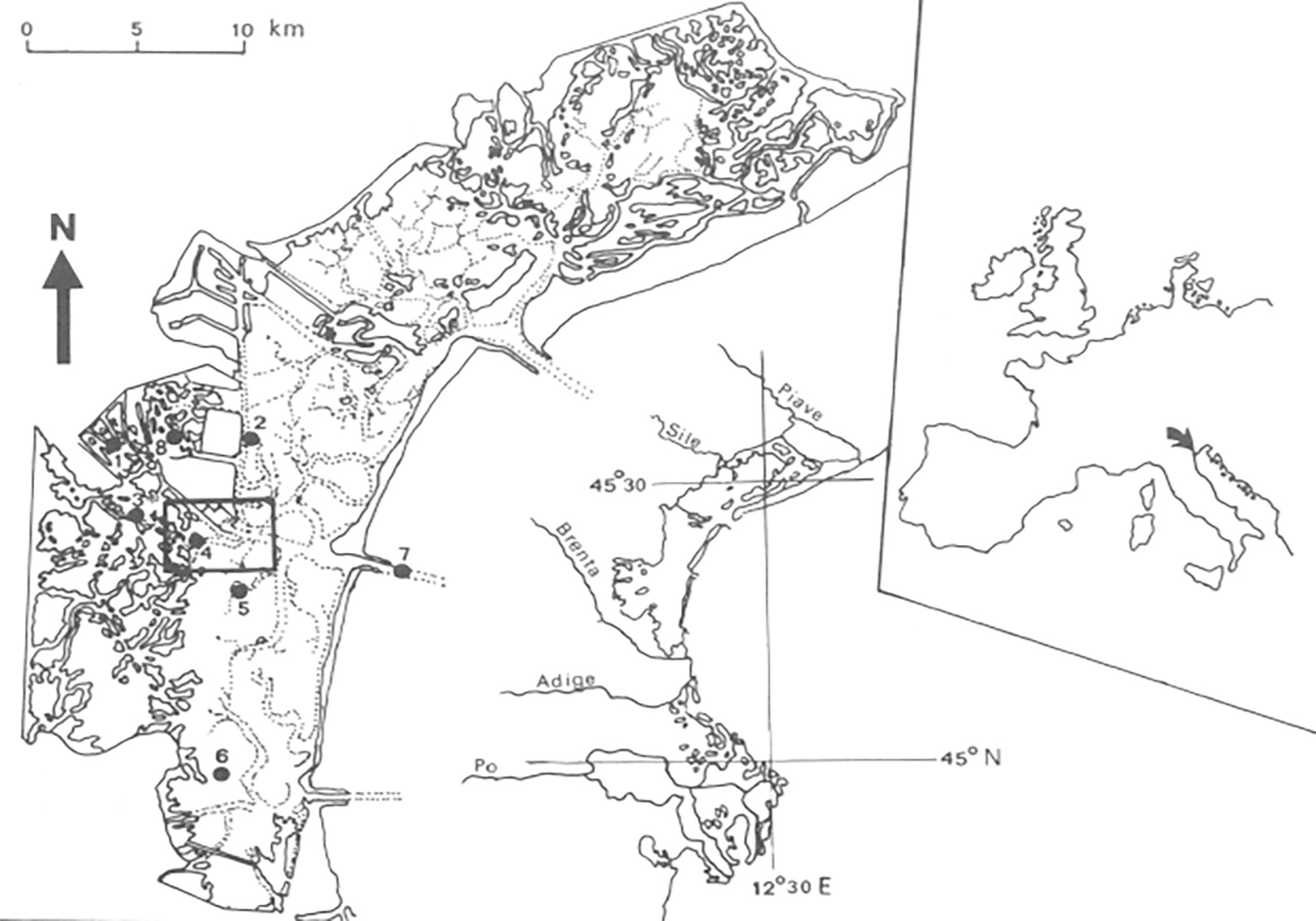
Torson was a remote corner of the lagoon between the Ravaglio and Rivola marshes, along the Piovega canal. The Department of Civil Engineering for Maritime Works had proposed before the Second World War, and again in 1953, the opening of a navigable canal between the mouth of Malamocco and the industrial area of Marghera, on the mainland.
The initial project was regularly extended to reach its final form with the law of 2 March 1963. Since the canal was dug for the passage of oil tankers, the peninsula that was once called Torson di Sotto has suffered so much erosion that there is almost nothing left.
A core sample was taken in 1977(2) near the N edge of Torson di Sotto, as part of a reconnaissance campaign of the Holocene lagoon sediments, using a 40 mm diameter Dachnowsky probe. A second, deeper drilling showed that the estuarine or lagoonal silts, with rare fossils and some peaty or sandy traces, continued to a depth of about - 6.0 m, where they were replaced by continental-looking clays.
Shortly before the Roman occupation, a change of course, the details of which are still unclear, must have caused a branch of the Brenta River to emerge into a lagoon near Torson di Sotto: the environment changed from brackish (TS 15) to freshwater (TSl 2).
Towards the end of the Roman period, the lack of maintenance and, probably, an increase in rainfall, caused a hydrographic disorder in the Veneto near the lagoon mouths. This allowed the marshes to expand, limiting the tidal action downstream, trapping sediments from river floods and allowing the formation and deposition of coastal peat.
At the same time, the settling of the Holocene lagoon sediments, which were already several metres thick, continued slowly. To this settlement, which was particularly important for the peat layers, and consequently varied from one locality to another, was probably added the effect of a slight rise in relative sea level.
hrough archipelic thinking we can know the rocks of the smallest rivers for sure and envisage the water holes they cover where freshwater crayfish still shelter. The phrase act in your place, think with the world is now widespread. It can be found on the walls of the largest cities as well as on the traces of abandoned villages. With this remarkable injunction not to think in the world, which could reinvent the idea of conquest and domination, but to think with the world from which all sorts of relations and equivalences blossom.