EXHIBITION / DISPOSITIFS &
INTERSTICES
PARTNER / LES URBAINES
abstract / A project questioning the permanent state of crisis, its tensions and implicit effects.
LOCATION / LAUSANNE, 2012
STATEMENT
According to the definition of the Italian philosopher Giorgio Agamben, a device is anything that, in one way or another, has "the capacity to capture, orientate, determine, intercept, model, control and ensure gestures and behaviours, opinions and discourses " within a particular system.
In this sense, literature, art and philosophy, agriculture, engineering, mobile phones and electric motors, digital devices and national pavilions at world's fairs can all be considered as tools.
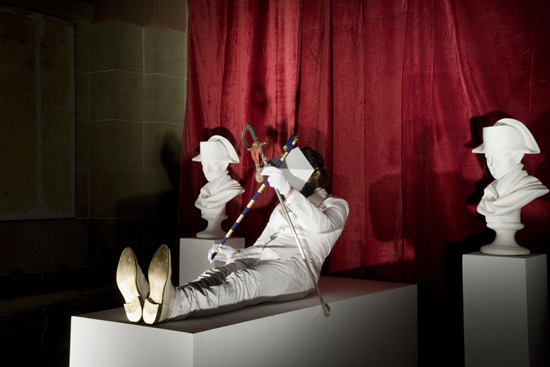
Augustion Rebetez and Noé Cauderay use seemingly discordant assemblages and asymmetrical compositions to multiply the possibilities for interpretation. Not without a slightly wry, offbeat sense of humour, they develop a multi-faceted body of work.

Uriel Orlow works in the interstices of history, between proven facts and fragmentary reconstructions of the past. His work asks us what we can say about history and what its shadows can reveal.
In Remnants of the Future, the ghost town of Mush, whose construction was interrupted by an earthquake in 1988, was left unfinished by the collapse of the Soviet Union. The city becomes the emblem of an absence, haunted by the spectres of an economic, political and ideological collapse.
In Melodie Mousset's work, the body is conceived as both a physical and symbolic entity, a tangible manifestation of individuality, of belonging to a particular gender, and a primordial vector of social interaction. In On stoning and unstoning, the artist stages her own body and appears covered in stones, a material with ambivalent symbolism, evoking sculpture or ritual as much as violence. This unexpected semantic shift creates a tension between creation and destruction, punishment and defence, power and submission.
Whether it's Zimoun's monumental structures that are both rigorous and random, Aldo Mozzini's strange and improbable pavilion, Lucas Herzig's entropic refluxes, Augustin Rebetez and Noé Cauderay's rhizomic and decadent arrangements, the architectural ghosts of Uriel Orlow, or the latent tension that emerges from the images of Mélodie Mousset, these are the more or less unexpected effects, the unforeseen shifts that infiltrate the zones of indeterminacy of a dominant device.
In this way, the gaps and interstices of the system are revealed in all their fertile, overflowing ambiguity, and emerge, like ghostly entities, through the various works presented in the exhibition spaces.
PARTICIPATING
ARTISTS
ALDO
MOZZINI
PAVILLON
It is necessary to approach Aldo Mozzini's work in a contextual manner in order to understand the relationships his works have with their environment.
Particular attention is paid to the notion of space, taken in its historical and social dimension and as an interstice between the public and private spheres.
With a metaphorical device inspired as much by the Crystal Palace as by Dan Graham's structures, the artist questions both the exhibition space and the spaces beyond it.
AUGUSTIN
REBETEZ
& NOÉ
CAUDERAY
HYPER-MAISON
The works of Augustin Rebetez and Noé Cauderay, whether photographic arrangements, sculptural installations, drawings or videos, inhabit a universe that is at once mysterious, sparkling, grotesque and slightly decadent.
Through seemingly discordant assemblages and asymmetrical compositions, the artists multiply the possible interpretations. With a somewhat dark and offbeat sense of humour, they develop a multifaceted body of work.
LUCAS
HERZIG
REFLUX
Using materials that are unmistakably reminiscent of Arte Povera, Lucas Herzig approaches creation in a phenomenal way. The artist creates monumental sculptures and layered installations that evoke both complex, constantly changing systems and post-apocalyptic relics.
These structures, with their almost organic arrangement, literally take over the space, exuding a sense of strange and disturbing beauty.
MELODIE
MOUSSET
On stoning and unstoning
In Melodie Mousset's works, the body is conceived as both a physical and symbolic entity, a tangible manifestation of individuality, of belonging to a specific gender, and a fundamental vehicle for social interaction.
In On stoning and unstoning, the artist depicts her own body, her face covered with stones, an ambivalent material evoking sculpture or ritual as much as violence.
This semantic shift gives rise to and reveals a tension between creation and destruction, punishment and defence, power and submission.
URIEL
ORLOW
Remnants of the Future I
Situated halfway between proven facts and fragmentary reconstructions of the past, Uriel Orlow works in the interstices of history to reveal its grey areas.
In Remnants of the Future I, he films the ghost town of Mush, whose construction was interrupted by an earthquake in 1988 and remained unfinished following the collapse of the Soviet Union. Mush thus becomes the emblem of an absence, haunted by the spectres of economic, political and ideological failure.
The film's sound composition has been created by Mikhail Karikis.
ZIMOUN
80 prepared
dc-motors, cotton balls, cardboard boxes
Zimoun creates soundscapes using analogue mechanisms – electric motors and everyday materials such as cardboard – and presents an installation that offers the public an aesthetic experience that is both acoustic and visual.
Through the serial assembly of simple, functional modules, the artist creates minimalist-inspired architectural devices whose mechanical rhythms impose themselves and clash with one another in a rigorously organised space.