
EXHIBITION /UNDERGROUND
CONNECTIONS
LOCATION /LES URBAINES,
LAUSANNE, 2011
abstract /A project exploring
the underground of the city, where a flow
of interwoven layers emerges from
the depths.
STATEMENT
A KIND OF UNDERLYING AWARENESS LINKS THE VARIOUS ARTISTIC INTERVENTIONS IN THIS EDITION. FAR FROM EXPRESSING ANY ETHICAL OR POLITICAL JUDGEMENT, THE GUIDING THREAD THROUGH THIS EXHIBITION AT THE ESPACE ARLAUD IS A CONTROLLED SURVEILLANCE OF OUR SITUATION. THE CRISIS IS CONSTANTLY PRESENT IN THE MEDIA AND SUMMONED TO TELEVISION DEBATES.
IT SEEMS TO INHABIT, OR EVEN SATURATE, OUR DAILY LIVES. TO SUCH AN EXTENT, A KIND OF ACCEPTANCE SETTLES IN WITH APPARENT NORMALITY. IT FEELS AS IF THE CRISIS WERE AN INTRINSIC AND NECESSARY PART OF OUR SYSTEM. OF COURSE, THERE IS NOTHING NEW ABOUT THIS SITUATION. CRISES HAVE ALWAYS MARKED HISTORY. THEY BRING BOTH DEADLOCK AND CHANGE TO EXISTING ECONOMIC, SOCIAL, OR CULTURAL SYSTEMS.
IN A DEFINITION THAT IS NOW CANONICAL, MICHEL FOUCAULT DESCRIBES THE DISPOSITIF AS THE NETWORK THAT CAN BE TRACED BETWEEN THE DIFFERENT ELEMENTS OF A HETEROGENEOUS WHOLE, INCLUDING LAWS AND INSTITUTIONS, URBAN AND ARCHITECTURAL PLANNING, STRUCTURES FOR SURVEILLANCE AND THE ORGANISATION OF POWER, AND SCIENTIFIC, PHILOSOPHICAL AND MORAL FORMULATIONS.
SECONDLY, INSOFAR AS THE SYSTEM OUTLIVES THE INTENTIONS BEHIND ITS CREATION, IT IS MAINTAINED BEYOND THE INITIAL STRATEGIC OBJECTIVES THROUGH A CONTINUOUS READJUSTMENT OF ITS CONSTITUENT ELEMENTS IN ORDER TO MANAGE THE EFFECTS, INTENDED OR UNFORESEEN, THAT IT HAS ITSELF GENERATED.
IN THIS DYNAMIC, EMERGENCE AND DISCIPLINE, SPONTANEITY AND CONSTRAINT, FREEDOM AND COERCIVE DISPOSITION ENGAGE IN A MOVEMENT OF CONSTANT READJUSTMENT IN THE HOPE, DESIRE OR ILLUSION OF MAINTAINING THE DOMINANT ARRANGEMENT IN PLACE. THIS SYSTEM, HOWEVER, IS NOT A PRECISELY LOCATABLE ENTITY, BUT RATHER A SET OF HETEROGENEOUS ELEMENTS, A DYNAMIC STRUCTURE COMPRISING A MULTITUDE OF OTHER CONSTITUTIVE SYSTEMS.
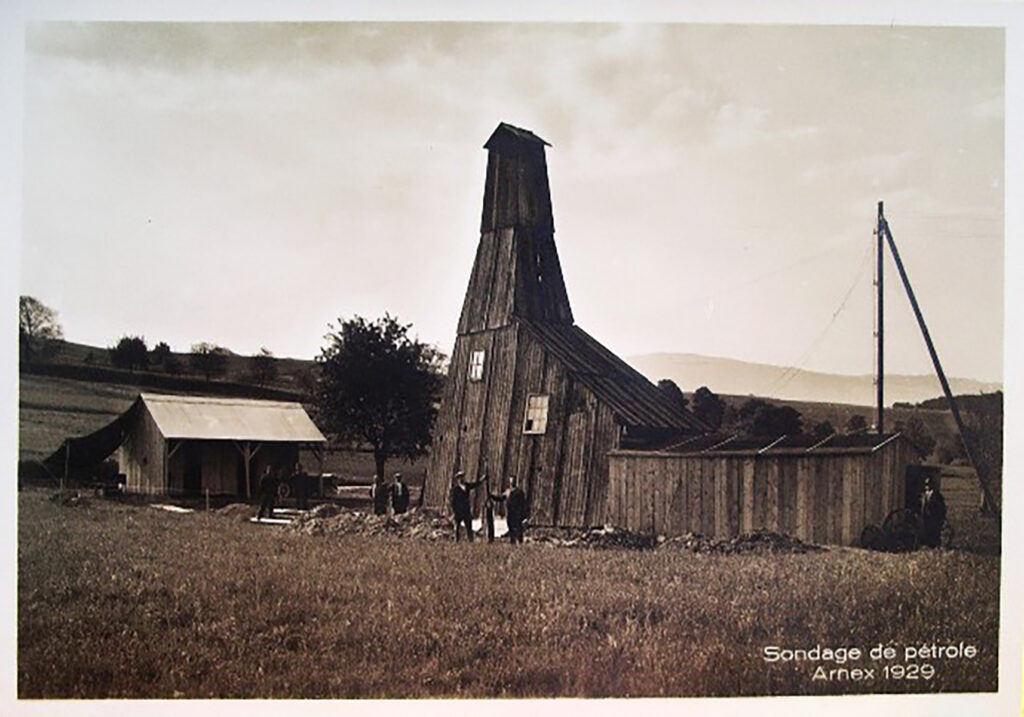
There are documents about local urbanism and objects evoking underground and parallel stories, such as a 1912 swiss oil drum borrowed from the Geology Museum. These objects mix with the artistic projects: a research about the very special Israeli Army war strategy and inspired by Deleuze and Guattari’s theory (Monya Pletsch), the theorization of a Maelström-based society (Aurélien Gamboni), the construction of a mythology about antimatter (Kara Uzelman), and also Adrien Lohmüller’s Water Portraits, liquid records obtained by washing clothes via a filtering system designed by the artist.
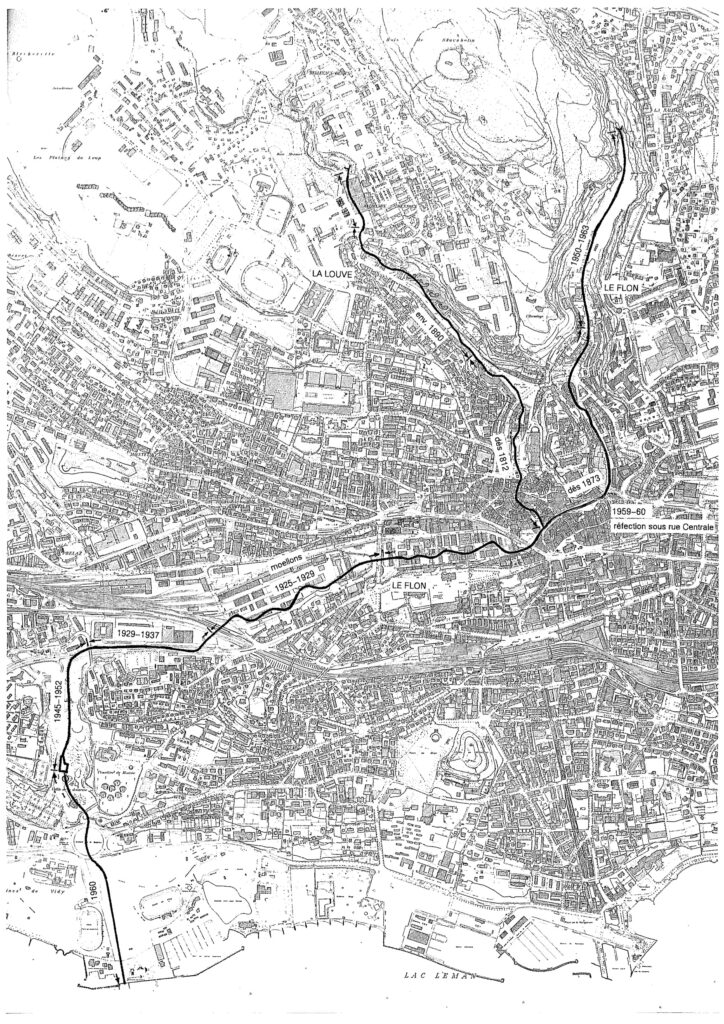
As our approach is inspired by Archeology, we asked the artists to capture and to reveal this idea of stratification. The aim was to question the urban structure of the city and to look deeper through the visible surface. La Riponne’s secret underground gathers together various imaginations where the oil flux meets the rivers’ flux, where the various town’s stories lead to one point, a place that finally only belongs to our imagination.
PARTICIPATING
ARTISTS
ADRIEN
MISSIKA
NO MATTER
Whether taken on the spot or reconstructed in the studio, Adrien Missika's images reveal a latent ambiguity in which aesthetic and spatio-temporal reference points seem constantly to be called into question.
He develops a language that questions both the plastic quality of the image and its representational status, tackling notions such as entropy and potential archaeology.
No matter is a work of great formal simplicity - a wall with a hole in it, overlooking the unknown - that plunges the viewer into an indeterminate dimension, somewhere between an explosion and an abyss, an erosion and an artifice.
ATHENE
GALICIADIS
HOW TO SAVE MY PLANTS
Athene Galiciadis' work is characterised by a formal search that is both rigorous and intuitive. A tension between structured geometries and more organic forms is regularly apparent in her drawings, paintings and sculptures. In the windows of the Barre tunnel, she has created a discreet installation that adds an intimate, personal dimension to the space.
Travelling abroad for the duration of the exhibition, she devised a practical - but aesthetic - way of watering her green plants. How to Save My Plants (Map of) is a series of sculptures integrated into the tunnel's display cases, on which the artist's plants will be placed.
AURÉLIEN
FROMENT
PULMO MARINA
Against a uniform Klein blue background, a yellow jellyfish undulates its stinging tentacles like a fragment of living lace, while a somewhat official voice-over describes its baroque anatomy, voracious cannibalism and biological ancestry.
BAPTISTE
GAILLARD
Une terrasse comme miroir aux endives et à la cosmologie
You can't look at Baptiste Gaillard's work without thinking that our world has reached a breaking point, due to automatism. Whether in the world of art, design or mechanics, forms and motifs are endlessly repeated at an increasing, frantic pace. By collecting fragments of objects, relics of everyday life and the detritus of an archaeology of the present, Gaillard creates installations that evoke an art history that is very recent, but in some ways already obsoletE.
EMRE
HÜNER
JUGGERNAUT
Juggernaut, by Turkish-born artist Emre Hüner, exudes a strange, suspended atmosphere. A surprisingly reassuring voice, taken from a video made by General Motors in 1940, accompanies a montage of found footage and sequences directed by the artist.
Alternating between excerpts from Walt Disney animations and NASA propaganda films, Emre Hüner evokes a dystopian universe in which the more or less unattainable aspirations of post-industrial society promise magnificent techno-idealistic horizons, yet leave the possibility of implacable destruction hanging in the air.
FLORIAN
GRAF
WEEK AND WAIT
After studying architecture, Florian Graf turned his attention to its application to the social fabric. His work ranges from the design of incongruous housing modules to ephemeral structures mediating utopian urban planning projects, and includes a critical theory of modern architecture and its founding elements. In a whimsical way, the artist recontextualises architectural models from recent history, projecting them into a fictitious and improbable future.
GORDON
MATTA CLARK
PARIS UNDERGROUND
Matta-Clark explores the subsoil of Paris and reveals the complexity of underground spaces, showing architectural ruins, car parks, tunnels, ossuaries, cellars and crypts in the Opéra district.
NICOLA
MARTINI
Through their use of organic materials (resins, cement, acids), the sculptors Nicola Martini and Vittorio Cavallini are interested in matter and more particularly in the elementary processes of sculpture: those that we observe, those that we only grasp intuitively.
During Les Urbaines, they will be accompanied by musician Attila Faravelli. Their headquarters will be in the fourth basement of the Place de la Riponne car park, the only place in Lausanne where you can see the River Louve and have direct access to the sewers.
RICCARDO
ARENA
25.765
IL PROFESSORE 5
IL PROFESSORE takes the form of a visual and textual composition obtained by editing several videos from the artist's personal archives. The various characters filmed appear as multiple facets of a single subjeT.
IN 25.765 Mountains and rivers changed places and roads were destroyed. In some places, the ground suddenly rose up and formed new hills, or it sank in abruptly and became new valleys. In other areas, a stream burst out in an instant, or the ground broke and new gullies appeared.
STEFAN
BURGER
Whether in the form of large-format photographs, staged objects, images or films, the photographic medium plays a central yet ambiguous role in Stefan Burger's installations.
Claiming to be more photographic than photographic in the strict sense of the term, the artist questions the scaffolding used to create a work and the mechanisms by which it is received.
As part of the [CONTRE]CULTURE/CH exhibition, on the theme of counterculture in Switzerland, Burger is working in the interstices of the exhibition spaces at the Musée de l'Élysée.
YVES
METTLER
OIL RIG
Artist Yves Mettler's work deals with a little-known chapter of Swiss history at the beginning of the 20th century: the existence of oil wells in the subsoil of the canton of Vaud. On the Place de la Riponne, the artist reconstructs the impressive derrick of a 1929 borehole in Arnex-sur-Orbe.
The work, the old Romandie cinema and the Espace Arlaud in an imaginary way.
Yves Mettler's installation was co-produced with the Musée cantonal des Beaux-Arts/Lausanne, which will be presenting the project as part of the 9=10 exhibition. Carte blanche to the Accrochage [Vaud] winners
MONYA
PLETSCH
UN-WALLING
Monya Pletsch is presenting a new version of her Un-walling project. The starting point for this work is an Israeli army general's surprising interpretation of the notion of smooth space formulated by Deleuze and Guattari. In opposition to striated space - organised by the authorities - smooth space is a fluid territory, without borders, that defies the established order and its control mechanisms.
In its military version, this libertarian fluidity becomes a strategy of war: ignoring the walls, the passages used by the soldiers to move around are dug through the buildings using explosive charges.
ANDREI
UJICA
OUT OF PRESENT
In May 1991, Soviet cosmonauts Anatoli Artsebarski and Sergei Krikalev were sent to the MIR orbital station. During this mission, in August 1991, the Moscow putsch took place, the failure of which wiped the very name of the Soviet Union off the map and ended an entire historical era.
AURÉLIEN
GAMBONI
INTO THE MAELSTRÖM
Inspired by a short story by Edgar Allan Poe, the installation Into the Maelström raises social, political and environmental questions. Using drawings, images and a model of the imaginary Assembly of Catastrophes, Gamboni creates a constellation of fragments of different stories.
Oscillating between fiction and reality, the artist invites negotiators and architects, not to mention sociologist Norbert Elias, illustrator Fritz Eichenberg and Edgar Allan Poe himself.
His reflective approach multiplies the levels of reading, questioning the whirlpools of history.
Collaboration: Alban de Haller (architect), Dylan Perrenoud (photographer) and Sandrine Teixido (anthropologist).
RAPHAËL
JULLIARD
MARELLE
The nature of Raphaël Julliard's works is both offbeat and ambiguous. Using rhetorical figures and clever wordplay, the artist ironically plays with the semantic shifts that creep in between his works and their accompanying titles. During the festival, the artist will be working in the archaeology, history, geology and zoology museums at the Palais de Rumine.
By insinuating himself more or less visibly into the various institutions, collections and exhibitions, he will confound the different levels of interpretation and artistic, cultural and historical references.
Guided tours organised by the Haute école d'art et de design, starting from the ticket office of the Palais de Rumine.
PASCAL
SCHWAI-GHOFER
The artisanal practice of art is one of Pascal Schwaighofer's main inspirations. His works reflect on his original process. Beyond a simple reference to the archaic world, Schwaighofer envisions formal research as a meditation on the nature of the surface of things.
His works are places of encounter and appearance where layers of different natures come together. For Les Urbaines, the artist takes over the Shoe Museum and collaborates with the founders of this wonderful little museum in the Rôtillon district, dedicated to faithful reproductions of sandals, shoes, clogs and other boots, from antiquity to the pre-industrial era.
ADRIAN
LOHMÜLLER
Klärwerk
Adrian Lohmüller is fascinated by the invisible structures of our everyday lives, the devices that surround us and that unconsciously organise a large part of our lives automatically. In his artistic practice, he creates simple, aimless experiments, performances whose purpose is practical experimentation rather than its outcome.
In 2011, he reproduced the sewage system of a small village on a reduced scale and used it to wash the dirty laundry of the participants in the experiment. The result is a series of liquid samples making up the Water Portraits series, which will be on show at the Espace Arlaud.
KARA
UZELANN
The Cavorist Project
A Canadian artist with an atypical background, Kara Uzelman studied urban planning, archaeology and the visual arts. Her work adopts disparate attitudes: installation, narrative, performative or site-specific, her works are based on the artistic process itself and can change configuration depending on their presentation.
In the installation The Cavorist Project, the artist uses objects and documents to enrich the myth of Joseph Cavor, an incongruous character from a science-fiction novel by H. G. Wells, who is said to have discovered the existence of matter that causes antigravity.